She Was Never a Metaphor
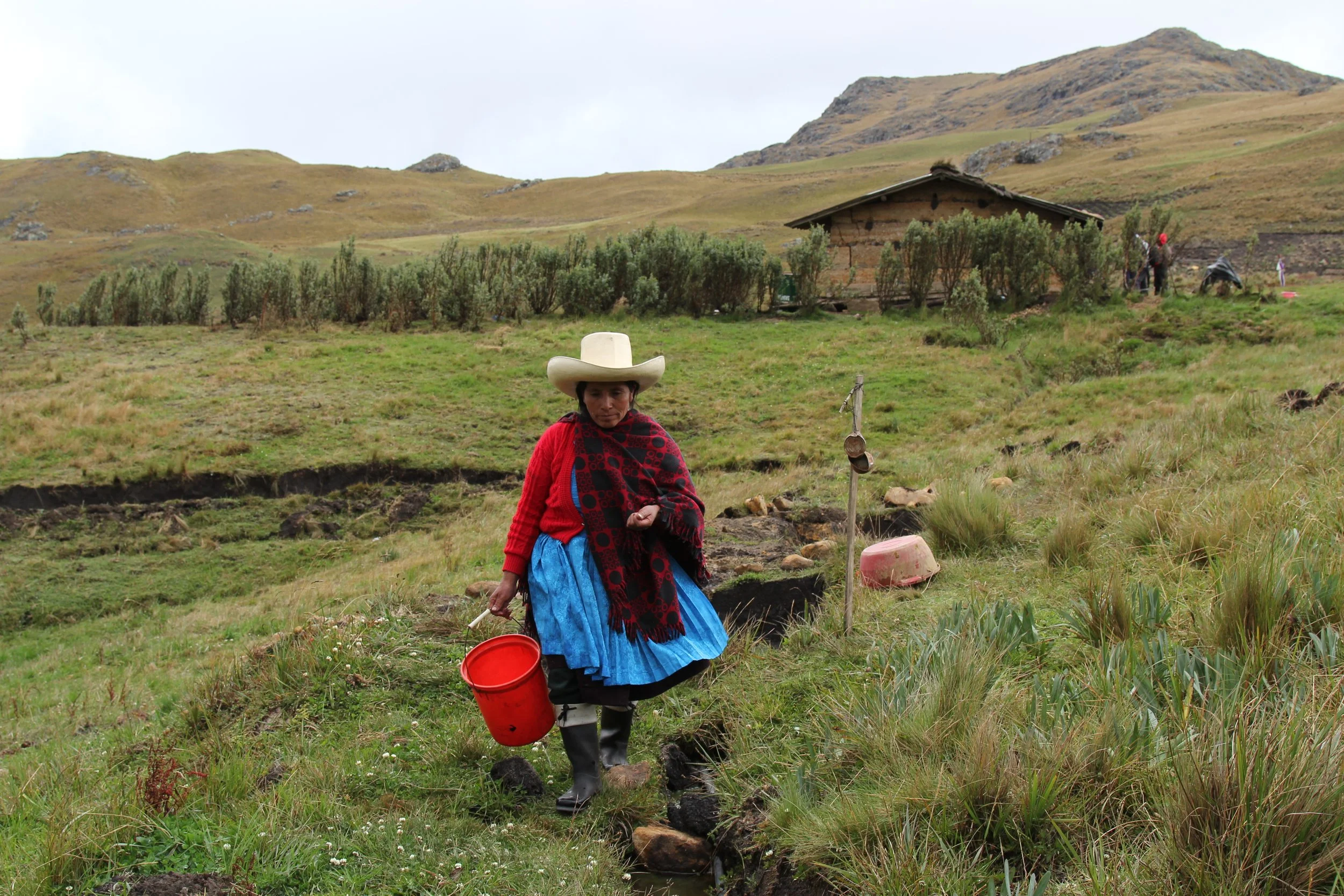
Máxima Acuña tends to her land in Tragadero Grande. (Photo: Goldman Environmental Prize)
Word count: 820 words approx.
There is a blue lagoon high in the northern Peruvian Andes, above 4,000 meters, where the grass turns silver when the wind comes through. The locals call it Laguna Azul, and for more than a decade, a woman named Máxima Acuña has refused to leave it.
Máxima is a farmer. Her home sits on a plot of land called Tragadero Grande, in the Cajamarca region, where nearly half the land has been handed over in mining concessions. The Yanacocha gold mine, the largest in Latin America, lies ten miles away. When the gold deposit started running dry, the mining company looked at Laguna Azul and saw a waste pit. Máxima looked at the same water and saw what her family drinks.
“She refused to let the mining company take over her home and pollute Mother Earth”
She refused to let the mining company take over her home and pollute Mother Earth. What follows is something horrible but unfortunately also very common for Latin American activists. Security forces came to her property. They destroyed her house, burned her crops, killed her animals, and beat her and her entire family. They built a fence around her land and put up a watchtower to monitor her movements. She was sentenced to prison for squatting on land she owned. In 2014, a court overturned the sentence. Finally, the Peruvian Supreme Court cleared her of all charges. She is still there.
In 2016 she received the Goldman Environmental Prize and in the ceremony she did not give a speech. She sang. “Because I defend my lakes”, she sang, “they want to take my life”. In interviews, she has said something that stays with you long after you read it: I may be poor, I may be illiterate, but I know that our mountain lakes are our real treasure.
In Quechua and Aymara, that treasure has a name: Pacha Mama. Although it is usually translated as Mother Earth, in Andean cosmology, she is not only a metaphor. She is a living being. Someone you thank before you drink. Someone you ask permission from before you plant. Someone you apologize to for any transgression, given everything she provides.
Every year on 22nd April, International Mother Earth Day shows up at universities, companies, and institutions with corporate tree-planting photo ops and recycled-paper pledges. In the Andes, nobody needed a calendar date.
In 2008, Ecuador wrote Pacha Mama’s rights into its constitution, and Bolivia followed in 2010. The paperwork was new, though the relationship was ancient. Despite this, the extraction continued. The lithium in your phone battery, the gold in your earrings, the soy in your morning oat milk… they come from somewhere. They come from her.
But Things Are Changing
In March 2024, a court in the Peruvian Amazon granted legal personhood to the Marañón River, a thousand-mile tributary of the Amazon. It was the first time in Peru’s history that a river was recognized as a holder of rights. The case had been fought for over two years by Kukama Indigenous women who were tired of watching oil from a cracked state pipeline poison the water their children bathed in and drank. Mari Luz Canaquiri Murayari, the woman who led the fight, grew up on the river’s banks. In Kukama belief, the spirits of the ancestors rest on the river floor. The court ruled that the river has the right to exist free of contamination, and it named the Kukama as its guardians. In April 2025, Mari Luz received the Goldman Environmental Prize for her work.
“We can look at what we buy and ask where it was pulled from the ground, and who said yes, and who was never asked.”
This Mother Earth Day, if we want to honor her on our taps and in our clean cities, we can start by learning whose names are on each of these victories. We can support the Indigenous-led organisations that fund these legal battles. We can look at what we buy and ask where it was pulled from the ground, and who said yes, and who was never asked.
Máxima Acuña is still farming at Tragadero Grande. The lake is still blue. Every April, Earth Day asks us to remember the planet. Máxima never had the privilege of forgetting. Maybe the most honest thing we can do this month is to not plant a tree for a photo, but sit with that difference, and let it change what we do afterwards.
Sustainable Development Goals
The Sustainable Development Goals (SDGs) are a universal call to action to promote prosperity while protecting the planet.
This article is aligned with the following SDGs:
SDG 13: Climate Action
SDG 15: Life on Land
SDG 10: Reduced Inequalities
Learn more about International Mother Earth Day: https://www.un.org/en/observances/earth-day
References
Amazon Frontlines. (2019, July 11). Waorani people win historic appeal against Ecuadorian government. https://amazonfrontlines.org/chronicles/waorani-ecuador-victory-appeal/
Earth Law Center. (2024, March). Peru’s Marañón River wins rights recognition and Indigenous guardianship in court. https://www.earthlawcenter.org/blog-entries/2024/3/perus-maran-river-wins-rights-recognition-and-indigenous-guardianship-in-court
Goldman Environmental Prize. (2016). Máxima Acuña. https://www.goldmanprize.org/recipient/maxima-acuna/
Goldman Environmental Prize. (2025). Mari Luz Canaquiri Murayari. https://www.goldmanprize.org/recipient/mari-luz-canaquiri-murayari/
International Rivers. (2024, March 21). Press release: Landmark ruling — The Peruvian Court of Nauta recognizes the rights of the Marañón River. https://www.internationalrivers.org/news/landmark-ruling-the-peruvian-court-of-nauta-recognizes-the-rights-of-the-maranon-river-and-the-indigenous-communities-as-its-guardians/
Olivera, R. (2016, April 27). One woman’s victory against a mining giant in Peru. New Internationalist. https://newint.org/features/web-exclusive/2016/04/27/one-womans-victory-against-a-mining-giant-in-peru
Plurinational State of Bolivia. (2010). Ley Nº 071 de Derechos de la Madre Tierra. https://www.lexivox.org/norms/BO-L-N71.html
Author
Melissa Puerto Aguayo is an Erasmus Mundus Scholar studying software engineering for sustainability at Vrije Universiteit Amsterdam. Rooted in grassroots initiatives and youth spaces, including the UN ecosystem, she works alongside Indigenous and local communities across Latin America, with a focus on the Caribbean and Yucatán, supporting territorial defense and climate justice. She also moves through youth and feminist tech and climate justice spaces as an ambassador and organizer, including Women Techmakers, 1MYAC, IntegraCode, among others.