Who Carries the Water?
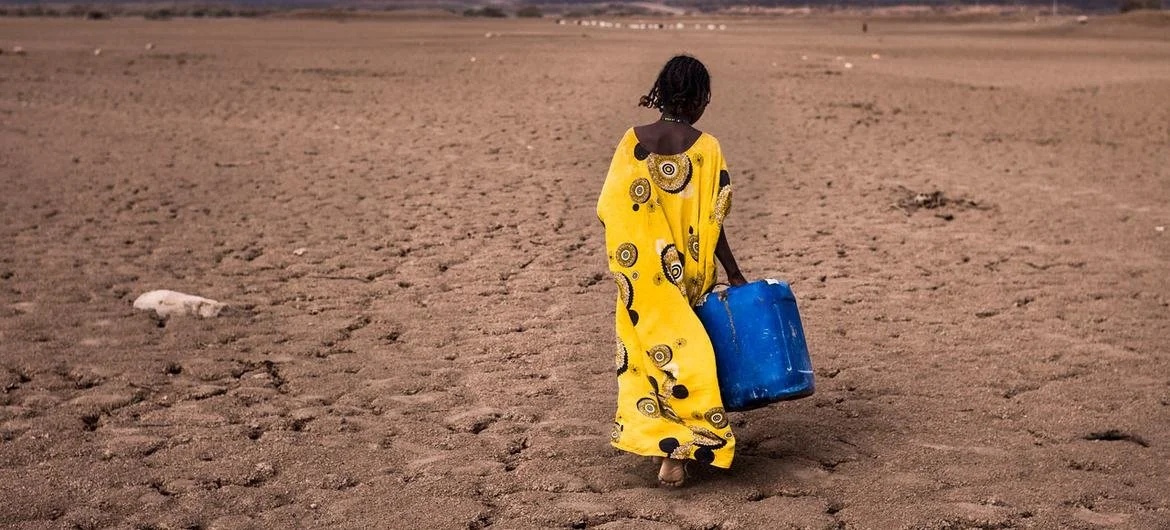
UNOCHA/Liz-Loh-Taylor Afar Region, Ethiopia
Word count: 770 words approx.
Estimated reading time: 3 minutes 15 seconds approx.
Think about the last glass of water you drank. Maybe five minutes ago? You walked to the kitchen, turned on the tap, and filled a glass. The whole process took about thirty seconds. Now picture doing that same thing, but the tap is a river. The river is four kilometres away. The glass is a twenty-litre jerry can that you have to balance on your head. And you are eleven years old!
This is not a metaphor. This is a Tuesday morning for millions of children inSub-Saharan Africaand parts of South Asia. And overwhelmingly, it is girls and women who do this walk. UNICEF estimates that women and girls collectively spend around 200 million hours every single day collecting water. That steals their time away from school, from rest, from earning a living and living their childhood.
Water scarcity is mostly framed as a resource problem. Not enough rain. Shrinking aquifers. Polluted rivers. All valid. But water scarcity is also a justice problem. It does not strike at random; it targets people already pushed to the margins. We can name rural communities, Indigenous populations, informal settlements, and, disproportionately, women are severely affected by the water crisis.
“In cities like Amsterdam, we have flush toilets with water that is cleaner than what many communities have available to drink.”
According to the WHO and UNICEF Joint Monitoring Programme report in 2025, 2.1 billion people worldwide still lack access to safely managed drinking water at home. Meanwhile, in cities like Amsterdam, we have flush toilets with water that is cleaner than what many communities have available to drink. That gap is not just geographical. It is political. Decisions about infrastructure investment, about who gets funding and whose complaints are taken seriously, are shaped by power.
Climate change is deepening this divide. Droughts are stretching longer. Floods are contaminating the limited clean water that communities depend on. And the people who hit first and hardest by the water crisis are, predictably, those with the least influence in global climate negotiations.
“A single cotton t-shirt can require around 2,700 liters of water to produce.”
What can global citizens do to solve the water crisis?
Start with a small decision: Perhaps you have heard before about the impactful footprint of the fashion industry. It turns out that this industry is one of the most water-intensive industries on the planet. According to the World Wildlife Fund, a single cotton t-shirt can require around 2,700 liters of water to produce, often sourced from water-stressed regions. Choosing secondhand clothing or supporting brands that are transparent about their supply chains is a water decision, even if it does not feel like one.
Talk about water differently:Water justice connects to the food you eat, the energy you use, and the trade policies your government supports. Ask questions: who benefits when water systems are privatized? Who loses access when prices rise? These are not abstract debates. They affect real households.
Support grassroots communities: Organisations such as Water.org and community-led water groups in affected regions often achieve more with limited resources because their strategies are rooted in lived experience rather than boardroom assumptions.
Push for structural and policy change: The European Union imports water-intensive products from countries facing severe scarcity. Holding your representatives accountable to consider water footprints in trade policy is a responsible act in mitigating the water crisis.
Don’t forget to acknowledge the wins: There is a reason to believe that our efforts to solve the water crisis matter. Since 2015, nearly a billion people have gained access to portable water. Countries from Bolivia to New Zealand have begun recognizing the legal rights of rivers and waterways. Indigenous communities are leading the way. Just like Autumn Peltier, an Anishinaabe water activist, once said: “We cannot eat money or drink oil.” The water conversation needs exactly that kind of clarity.
World Water Day falls on 22nd March. It is a reminder to think about how to increase access to safe and portable water for the communities most deprived of it. But reminders only work when they lead somewhere. The eleven-year-old girl walking four kilometers before sunrise does not need our awareness alone. She needs a tap. And the good news is that tap is not impossible, and we can all contribute to make it a reality.
Sustainable Development Goals
The Sustainable Development Goals (SDGs) are a universal call to action to promote prosperity while protecting the planet.
This article is based on the SDG 6: Clean Water and Sanitation
Learn more about World Water Day: https://www.un.org/en/observances/water-day
References
Peltier, A. (2019, September 28). Address at the Global Landscapes Forum, United Nations Headquarters. CBC News. https://www.cbc.ca/news/world/canadian-indigenous-water-activist-autumn-peltier-addresses-un-on-clean-water-1.5301559
United Nations Children’s Fund. (2016, August 29). Collecting water is often a colossal waste of time for women and girls. UNICEF. https://www.unicef.org/press-releases/unicef-collecting-water-often-colossal-waste-time-women-and-girls
Water.org. (n.d.). The water crisis. https://water.org/our-impact/water-crisis/
World Health Organization & UNICEF. (2025). Progress on household drinking water, sanitation and hygiene 2000–2024: Special focus on inequalities. WHO/UNICEF Joint Monitoring Programme. https://www.who.int/publications/m/item/progress-on-household-drinking-water--sanitation-and-hygiene-2000-2024--special-focus-on-inequalities
World Wildlife Fund. (n.d.). The impact of a cotton t-shirt. WWF. https://www.worldwildlife.org/stories/the-impact-of-a-cotton-t-shirt
Author
Melissa Puerto Aguayo is an Erasmus Mundus Scholar studying software engineering for sustainability at Vrije Universiteit Amsterdam. Rooted in grassroots initiatives and youth spaces, including the UN ecosystem, she works alongside Indigenous and local communities across Latin America, with a focus on the Caribbean and Yucatán, supporting territorial defense and climate justice. She also moves through youth and feminist tech and climate justice spaces as an ambassador and organizer, including Women Techmakers, 1MYAC, IntegraCode, among others.