The Crime of Crimes: Honoring Dignity Amidst Genocide in Palestine
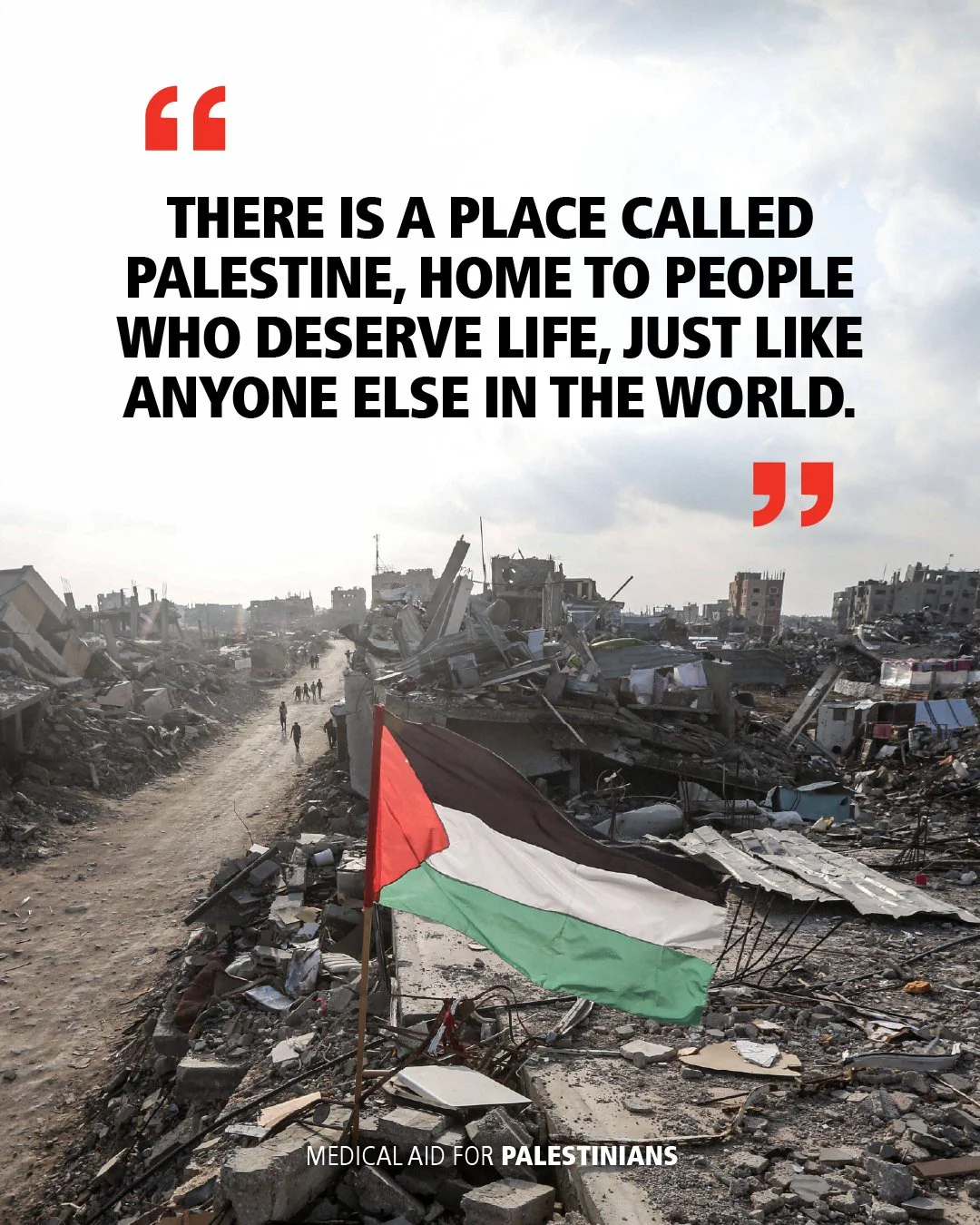
Photo Credit: Medical Aid for Palestinians (2025)
Word count: 833 words
Estimated reading time: 5 min
Picture a courtroom back in 1948. Grief hung heavy in the air, fresh from the horrors of the Holocaust. The world, still mourning, pledged together: "Never Again." Out of that moment emerged the Genocide Convention, which defined the “crime of crimes,” and committed to preventing it, not just punishing it afterwards.
Jump ahead to December 9th, 2025. This day, we take part in the tenth anniversary of the International Day of Commemoration and Dignity of the Victims of the Crime of Genocide. We mark the day to honor those lost to genocide, remembering that their dignity matters. But this time around, what stares back isn't some distant past, it's happening now! The pictures in Gaza are not from pages torn out of a schoolbook; instead, they stream live, into our phones and TVs.
The Live Genocide in Gaza
Since October 2023, the Gaza Strip has seen one of the most brutal and devastating attacks against a civilian population in recent history. Over 90% of Palestinian residents are no longer living in their homes, and the fundamental infrastructure used for living has completely failed (UNOCHA, 2025). The UN Commission of Inquiry, by mid-2025, had declared that four out of five genocide acts were indeed being practiced in Gaza, along with the evidence of genocidal intent (UNHRC, 2025). The United Nations Environment Programme has revealed the genocide's impact in numbers: tons of debris, contamination of aquifers, and loss of over 90% of agricultural land (UNEP, 2025). The situation is not only a crisis of inequality but also ecocide.
Women and Children: The Most Vulnerable
Women and children are the most affected by the ecocide. Two years ago, the deaths of Palestinians exceeded 68,000, among whom 20,000 were children (European Commission, 2025. Since April, 2025, the number of pregnant and breastfeeding women found to be malnourished are increasing manifold in Gaza (Save the Children, 2025). Unfortunately, pregnant women in Gaza are denied basic sanitation facilities, with some forced to self-induced labor. Others are terrified of seeking essential prenatal care because of fears of bombing. And some lost their lives due to a lack of access to doctors (Save the Children, 2024). Mothers are resorting to poor substitutes for breast milk such as slurry of ground chickpeas or tahini which can increase the risk of malnutrition in the newborn babies in Gaza (Save the Children, 2025). The saddening situation of women and children in Gaza indicates the failure of meeting the sixth sustainable development goal of “clean water and sanitation”. Sustainability is often phrased in terms of resources, environment, and institutional actions. However, what does it mean when a whole community becomes unlivable?
From Witnessing to Action
This Genocide Prevention Day is the occasion to recall not only the victims of previous atrocities but also the early signs of today. Perhaps you are wondering: What actions can we take as students when genocide may be happening right under our noses?
Here are some practical tips:
Get involved: Donate to credible fundraising organizations working to provide relief to thousands of suffering Palestinians. For example: The Palestine’s Children’s Relief Fund. Know more: PCRF
Support divestment: Insist on transparency in institutional investments and consume in line with your values. BDS (Boycott, Divestment, Sanctions) provides a framework for nonviolent, rights-based change. Learn more: Palestine boycott list | Ethical Consumer
Break the silence: Speak up through all the channels you have, always from a place of respect and compassion. Talk to your professors and peers about humanitarian issues to stay informed and learn about activities you could participate in, such as fundraising events, teach-ins. On December 9th, don't just light a candle; also make your voice heard. Let's keep working towards a world where no one is left behind.
Take care of your mental health: Staying knowledgeable of what’s happening in the world can get heavy, so please remember to take care of your own well-being and lean on the people around you.
Know the resistance: Read the works of Palestinian authors, for example, Refaat Alareer, a writer, poet, professor, and activist whose recent poems focus on life in Gaza. The following is one of his last poems. I hope it stays with you as it did with me.
“IF I MUST DIE”
BY REFAAT ALAREER
If I must die,
you must live
to tell my story
to sell my things
to buy a piece of cloth
and some strings,
(make it white with a long tail)
so that a child, somewhere in Gaza
while looking heaven in the eye
awaiting his dad who left in a blaze—
and bid no one farewell
not even to his flesh
not even to himself—
sees the kite, my kite you made, flying up above
and thinks for a moment an angel is there
bringing back love
If I must die
let it bring hope
let it be a tale
Sources
Amnesty International. (2024, February 26). Israel defying ICJ ruling to prevent genocide by failing to allow adequate humanitarian aid to reach Gaza. Amnesty International. https://www.amnesty.org/en/latest/news/2024/02/israel-defying-icj-ruling-to-prevent-genocide-by-failing-to-allow-adequate-humanitarian-aid-to-reach-gaza/
European Commission. (2025, April 16). EU support to Palestinians – Factsheet. European Civil Protection and Humanitarian Aid Operations. https://civil-protection-humanitarian-aid.ec.europa.eu/where/middle-east/palestine_en
Farge, E. (2024, March 26). UN expert says Israel has committed genocide in Gaza, calls for arms embargo. Reuters. https://www.reuters.com/world/middle-east/un-expert-says-israel-has-committed-genocide-gaza-calls-arms-embargo-2024-03-26/
Save the Children. (2024, July 8). Women Facing Life-threatening Complications in Pregnancy after Nine Months of Gaza Conflict. https://www.savethechildren.org/us/about-us/media-and-news/2024-press-releases/gaza-women-facing-life-threatening-complications-in-pregnancy
Save the Children. (2025, August 4). Gaza: Over 40% of pregnant and breastfeeding women in Save the Children clinics malnourished. https://www.savethechildren.net/news/gaza-over-40-pregnant-and-breastfeeding-women-save-children-clinics-malnourished
United Nations Environment Programme. (2024, June 18). Environmental impact of the conflict in Gaza: Preliminary assessment of environmental impacts. https://www.unep.org/resources/report/environmental-impact-conflict-gaza-preliminary-assessment-environmental-impacts
United Nations Human Rights Council. (2025, September 16). Legal analysis of the conduct of Israel in Gaza pursuant to the Convention on the Prevention and Punishment of the Crime of Genocide (A/HRC/60/CRP.3). https://www.ohchr.org/sites/default/files/documents/hrbodies/hrcouncil/sessions-regular/session60/advance-version/a-hrc-60-crp-3.pdf
United Nations Office for the Coordination of Humanitarian Affairs. (2025, October 2). Humanitarian situation update #327: Gaza Strip. https://www.ochaopt.org/content/humanitarian-situation-update-327-gaza-strip
United Nations. (n.d.). Goal 16: Peace, justice and strong institutions. Sustainable Development Goals.https://sdgs.un.org/goals/goal16
Sustainable Development Goals
The Sustainable Development Goals (SDGs) are a universal call to action — for all countries, whether poor, rich, or middle-income — to promote prosperity while protecting the planet (Read more: https://sdgs.un.org/goals).
This article is based on SDG 6: Water and Sanitation (Read more: Goal 6: Water and Sanitation - United Nations Sustainable Development).
Since 2015, December 9 is celebrated as the International Day of Commemoration and Dignity of the Victims of the Crime of Genocide and of the Prevention of this Crime (Read more: International Day of Commemoration and Dignity of the Victims of the Crime of Genocide and of the Prevention of this Crime | United Nations).
Author
Melissa Puerto Aguayo is an Erasmus Mundus Scholar studying software engineering for sustainability at VU Amsterdam. Rooted in grassroots initiatives and youth spaces, including the UN ecosystem, she works alongside Indigenous and local communities across Latin America, with a focus on the Caribbean and Yucatán, supporting territorial defense and climate justice. She also moves through youth and feminist tech and climate justice spaces as an ambassador and organizer, including Women Techmakers, 1MYAC, IntegraCode, among others.