Word count: 1073 words
Estimated reading time: 5 mins 30 seconds
I have been trying to shop for plant-based foods as much as possible/ been vegan for X amount of time. Because I care about the environment and/or I want a healthier lifestyle. But, how do I convince someone who doesn’t see the value of plant-based diets?
Have you ever been in a situation trying to start a conversation about veganism and faced backlash? Have you felt doomed by the “I want my cheeseburgers over the planet” argument? You are not alone. I have been there too and that’s why I thought of writing something about it.
This article is a one-stop guide on how to start a conversation about veganism – at the dinner table, during a coffee break, or on a long walk…you get the idea.
Why veganism?
Plant-based diets are slowly becoming popular. A collaborative research by YouGov and Veganuary revealed that approximately 25.8 million people worldwide tried veganism in January 2025. The University of Oxford suggests that opting for a plant-based diet can significantly reduce an individual’s food‑related carbon footprint by up to 73%, making it one of the most impactful climate actions a person can take. For instance, every one calorie of beef needs 40 calories of fuel and each calorie of milk needs 14 fuel calories. Whereas, one calorie from grains needs 2.2 fossil fuel calories (Pimentel & Pimentel, 2003; Reijnders & Soret, 2003). Isn’t that enough to switch to more plant-based foods? Not always!
Have you heard the saying, “people change when they want to change”? But behavioral scientists say that people change in the right environment (Burke et al., 2009). Do you want to be the one who creates the right environment for people to switch from an animal-based to a more sustainable, i.e., plant-based lifestyle? We have got your back!
5 go-to hacks to talk about veganism in your circle!
1. Share your experience: be realistic
Remember when you switched to a plant-based lifestyle? Share the challenges you faced and how you overcame them.
I would give my example. When I tried to boil soy milk for my chai, it curdled. For once, I thought of giving up soy milk and switching back to dairy milk. I paused. Tried boiling soy milk and tea water solution separately. Guess what? It worked. Now, I try to drink tea with plant-based milk as much as possible. Secret: it tastes exactly like dairy milk.
P.s.- Make sure not to boil the milk for more than 2 minutes.
2. Be ready with mind-blowing stats
Ever heard that vegan diets are way too expensive? I thought so too. Until I read the groundbreaking research by the University of Oxford, which found that vegan diets can reduce grocery bills by ⅓ rd compared to animal-based diets.
You need more of these stats to support the vegan conversation. Let data be your superpower! You can also share the nutritional benefits of vegan foods. For example, “Did you know a lentil burger patty has 60 times more fibre than a beef patty”? (Chaudhary & Tremorin, 2019).
3. Address the elephant in the room- protein!
Now that we are talking about nutrition, protein is one of the essential nutrients we cannot miss. Some people often argue that vegan diets lack protein. However, that’s not true (Papier et al., 2019). Plant-based diets offer many rich sources of protein. Imagine tofu, chickpeas. See more sources below.
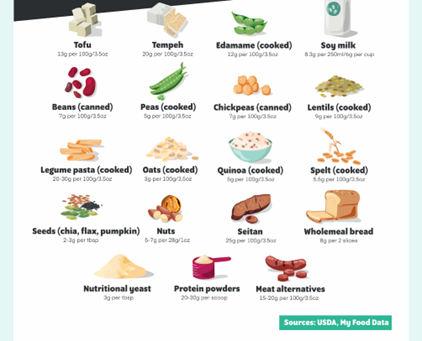
Taken from: Veganary Plant Protein Cookbook UK
You can also give examples of sportspersons who thrive on a vegan lifestyle. Name famous athletes like Lewis Hamilton, Morgan Mitchell, and Hector Bellerin. All of them report significant improvement in health and athletic performance since they went vegan.
Let’s acknowledge that not everyone would want to switch to a plant-based lifestyle– and that’s fine. But who said not to try a vegan dish?
4. Offer to Cook Vegan: Keep it a secret until they ask….
You have a weeknight dinner planned with friends. They ask you, “What’s on the menu?” Keep it a secret. Cook something vegan. Your favorite curry, pasta bolognese, or a chickpea salad. Let them eat until they ask, “Oh, is this vegan?” That’s your win.
P.s.- For inspiration, you might want to check out our plant-based recipes
5. Education- but keep it fun
Have a movie night planned? Why not make it about veganism?
While your friends are thinking about what to watch, you can say, “Hey, let’s watch this X movie. P.s.- There’s a documentary that captures the journey of 30 folks trying veganism for 30 days. See Food for Thought! See full list of documentaries on veganism at the end of this article.
What if they ask…..What difference would one person make?
You can answer that by sharing a small story. Once the forest was on fire. Birds living on the trees in the forest were scared. One of those birds filled her beak with water and tried to extinguish the fire. The other birds ridiculed her action, and commented, “how will your contribution stop the forest from burning”? The bird answered, “indeed, I cannot stop the forest from burning all by myself, but atleast, my name will be counted in the ones who did something to stop the fire.” That’s how you can contribute to making the planet less warm by buying more plant-based foods.
Concluding thoughts
Being vegan is a personal choice. You need not feel the burden to convince everyone.
Pick your moments. You don’t need to “win” every conversation. Sometimes planting a small idea is enough to ignite food for thought.
So, keep your protein in check, your salads bright, and your answers simple!
Sneak peek into how we celebrated VUganuary (VU’s version of Veganuary)!
We organized a plant-based cooking workshop in collaboration with SRVU. VU students cooked 20 litres of chickpea sweet potato soup together at the Green Office and served it on campus afterwards.
We watched the documentary, “Food for Thought”. It explored the inspiring journey of people worldwide who tried plant-based diets for 30 days!
See our VUganuary activities here!
Get your plant-based recipe featured!
Do you have a special plant-based recipe? You can now get it featured! We are accepting student inputs for our plant-based cookbook! See more information here.
Documentary recommendations to watch this Veganuary!
Available for FREE on YouTube!
References
Burke, N. J., Joseph, G., Pasick, R. J., & Barker, J. C. (2009). Theorizing Social Context: Rethinking Behavioral Theory. Health Education & Behavior. https://doi.org/10.1177/1090198109335338
Chaudhary, A., & Tremorin, D. (2019). Nutritional and Environmental Sustainability of Lentil Reformulated Beef Burger. Sustainability, 12(17), 6712. https://doi.org/10.3390/su12176712
Jessica. (2025, April 24). How to talk about veganism without sounding preachy. Simple Vegan Bytes. https://simpleveganbytes.com/how-to-talk-about-veganism/
Papier, K., Tong, T. Y., Appleby, P. N., Bradbury, K. E., Fensom, G. K., Knuppel, A., Schmidt, J. A., Travis, R. C., & Key, T. J. (2019). Comparison of Major Protein-Source Foods and Other Food Groups in Meat-Eaters and Non-Meat-Eaters in the EPIC-Oxford Cohort. Nutrients, 11(4), 824. https://doi.org/10.3390/nu11040824
Pimentel D, Pimentel M (2003). Sustainability of meat-based and plant-based diets and the environment. Am J Clin Nutr 78 (Suppl), 660S–663S.
Rachel. (2025, August 15). How many people took part in Veganuary 2025? The results explained. Veganuary. https://veganuary.com/en-us/how-many-people-took-part-in-veganuary-2025-the-results-explained/
Reijnders L, Soret S (2003). Quantification of the environmental impact of different dietary protein choices. Am J Clin Nutr 78 (Suppl), 664S–668S.
Sustainable eating is cheaper and healthier - Oxford study |. (2021, November 11). https://www.ox.ac.uk/news/2021-11-11-sustainable-eating-cheaper-and-healthier-oxford-study
Veganuary. (2026). Veganuary Plant Protein Cookbook (2026 EDITION). https://veganuary.com/wp-content/uploads/2025/10/Veganary_Plant_Protein_Cookbook_UK.pdf
Sustainable Development Goals
The Sustainable Development Goals (SDGs) are a universal call to action — for all countries, whether poor, rich, or middle-income — to promote prosperity while protecting the planet (Read more: https://sdgs.un.org/goals).
This article is based on SDG Goal 3: Good Health and Well-Being
Author
Vasundhara Pande works as an Education Officer at Green Office, Vrije Universiteit Amsterdam(VU) and studies Social Psychology at the VU. She applies her knowledge of behavioral science to drive sustainability education at the Green Office. You can find her organizing events like lectures, book discussions, and quizzes, or writing and curating recipes for the Green Office blog.