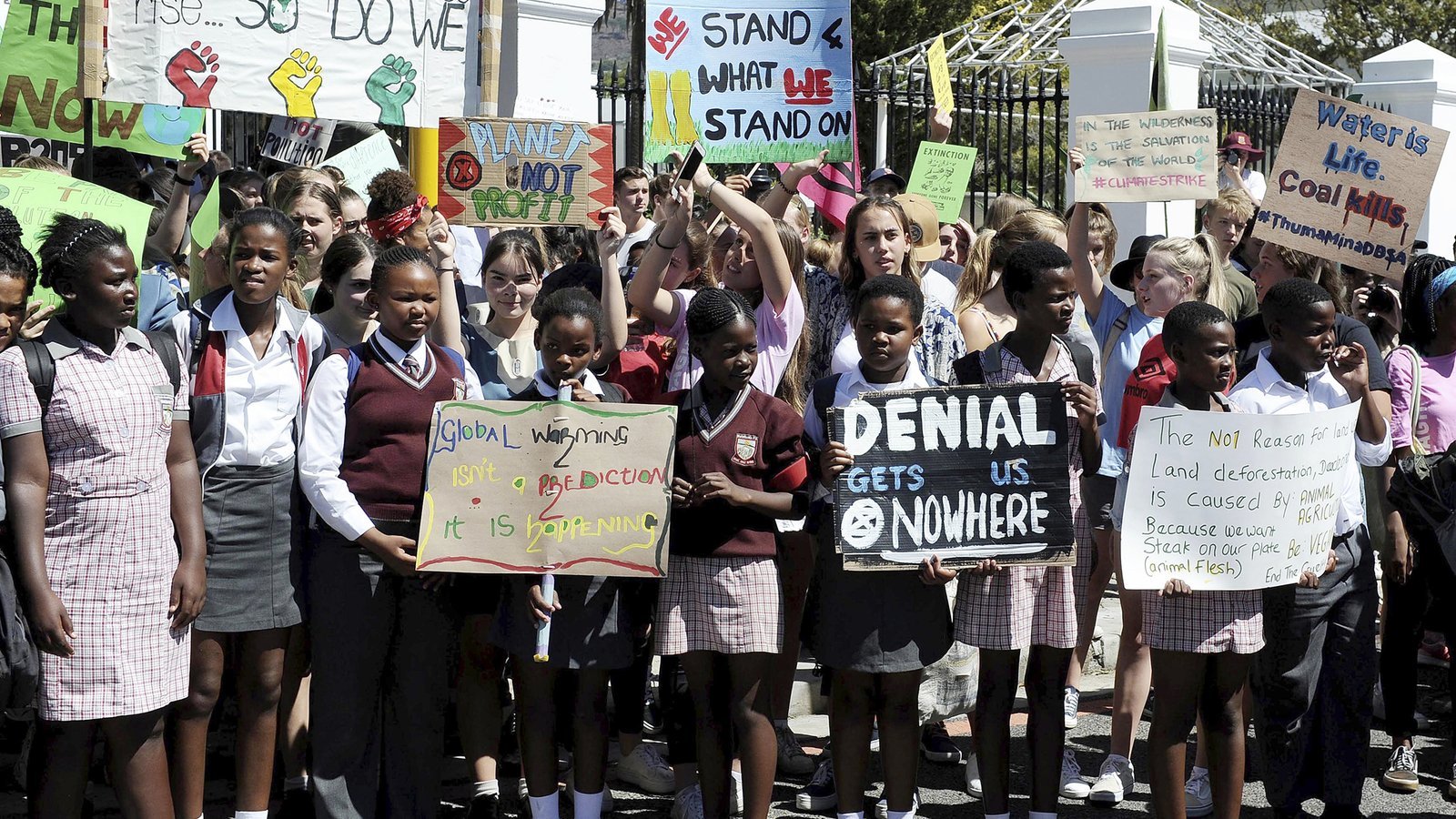
Students in Cape Town, South Africa take part in a protest, March 15, 2019 as part of a global student strike against government inaction on climate change. Students in cities worldwide skipped classes to protest their governments' failure to act against global warming. | Nasief Manie/AP
“At what point do you feel heard, in a relationship?” Reflect on the different relationships you have. Picture one of them. You are bothered by an issue. You bring it up. Talk about it and hope things will get better. At first, you feel listened to because you got the opportunity to talk about the problem. The other party takes note and seems to promise that things will change. The next day. Same story. They behave the same—no visible changes in what you had hoped to change. You raise the issue again. They listen (again). Nothing changes. How would you feel if you found yourself in such a situation? This is the analogy that Gabriel used to start his lecture at Green Office, Vrije Universiteit Amsterdam on 22nd January 2026. Most African youth climate activists are going through the precarious circumstance of being unheard in climate policy. Youth activists speak, policymakers seem to listen, but visible changes are marginal. A participation paradox that is discussed below.
The Participation Paradox
“What do you first think of when I say, youth climate activism?” Gabriel asked the audience a question. The enthusiastic audience jumped in, “Greta Thunberg”, “mass protests”, etc. The “usual suspects,” he called it. “Who among us can think of a group of young people who have been forced to form a collective after their homes are flooded, their parents burdened by poverty, and totally helpless? They live in a society where the youth are expected to protect society. They have the energy, so they can go out and fight. In frustration, their community tells them, “Go and fight this thing that is flooding our compounds and washing away our livelihoods–climate breakdown”. They go. Nothing in hand; only hope and the community’s trust. They can’t reach the media; they do not know about press releases. They can’t attend the Conference of the Parties (COP), and are denied visa to travel to such platforms. They attempt to engage the local leadership, who remind them of the huge debt burden that the government owes, unable to respond to their needs. They are advised to apply for grants from donors. Soon, they are weighed down by the amount of paperwork required. Their application is ultimately rejected for failing to meet “application requirements”. What do you do if you are this youth?
Through this lecture, Gabriel put us in the shoes of grassroots youth activists, who, with great hopes, try to raise their voice on the destructive reality of climate change. But youth voices continue to be ignored. Soon, he warned, their voices may go silent, and resort to other means to call attention. Such means, as history has taught us, may bring more social unrest than the climate breakdown. He prompted us to think of the structural barriers that hinder quantifiable progress in climate action. Through this “conversational lecture” and open engagement thereafter, Gabriel called attention to the work ahead and the need to include the youth voices, not for the show, but in recognition of the valuable contribution that they stand to bring.
Hopeless Hope
“Is there hope for the future?” A question emerged from the audience.
“Hopeless hope” The real question is not whether there is hope in climate youth activism rather, are institutions of power willing to transform hope into action? Here, hope resembles not a naive optimism, but a form of resilience rooted in action, community, and constant engagement despite systemic barriers. Be consoled that at least the word “hope” appears twice.” Gabriel concluded.
Gabriel’s Journey in Climate Activism
Gabriel has been known for his work leveraging writing and reading culture in East Africa, through Writers Guild-Kenya, a youth-driven initiative, which he founded in 2014. Through this platform, he noticed that young people desired a hopeful future for our climate. Gabriel produced pieces of art, poetry, spoken word, books, and theatre performances, and noticed a pattern. He described this pattern as “different routes, one desire.” He argued that many of the young people he interacted with were fundamentally climate activists. Even without knowing the meaning of the word. They championed a better society through their varied art.
Yet, as he looked around, the pace of change in the world moved slowly. Things seemed to change, sometimes to the worse. So, he asked, “How effective are climate activists in their desire to realize a lasting impact?” This question pushed him to pursue a PhD in impactful climate activism, to uncover parallels and hopefully provide a reflective understanding of how to make things better in the climate space. Gabriel Dinda is a Double Degree PhD Candidate at the University of Groningen and the University of Nairobi. His research highlights the nexus, gaps, and opportunities between youth activism and climate policymaking. Reachable through: g.d.olewe@rug.nl
Sustainable Development Goals
The Sustainable Development Goals (SDGs) are a universal call to action — for all countries, whether poor, rich, or middle-income — to promote prosperity while protecting the planet.
This article is based on the SDG goals:
SDG 13: Climate Action
SDG 16: Peace, Justice and Strong Institutions
SDG 10: Reduced Inequalities
Author
Vasundhara Pande works as an Education Officer at Green Office, Vrije Universiteit Amsterdam(VU) and studies Social Psychology at the VU. She applies her knowledge of behavioral science to drive sustainability education at the Green Office. You can find her organizing events like lectures, book discussions, and quizzes, or writing and curating articles for the Green Office blog.