Who Saved the Three Monkeys?
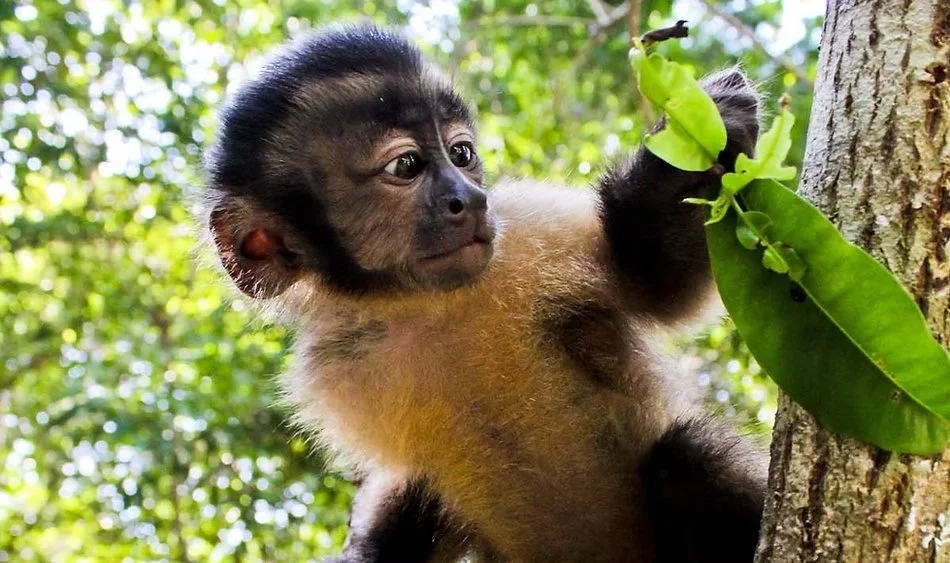
Credits: tasteofisla.com
Word count: 1120 words approx.
Estimated reading time: 5 minutes approx.
The little tamarin that came home
In 1969, a young Brazilian biology student named Cláudio Pádua was sitting in a classroom in São Paulo. His professor was talking about a small golden creature called the black lion tamarin, a primate so rare that nobody had photographed a living one in decades. The species, the professor said, was probably extinct.
The next year, by some impossible piece of luck, a small group of black lion tamarins was spotted deep in what was left of the Atlantic Forest. Most of that forest had been cut down for sugarcane and cattle. Inside one of the few remaining green islands, a handful of tamarins were still alive. Cláudio decided he would spend his life on this.
In 1984, he started a program that did something kind and simple. He went to the local farmers and asked them if they would mind leaving thin strips of trees standing between their fields. Just enough for a young tamarin to walk from one patch of forest to another and find a family. Many farmers said yes. Forty years later, the work continues, now in the hands of his colleague Gabriela Rezende, and there are around 1,800 black lion tamarins alive today in twenty patches of forest across São Paulo state. A species that was said to be gone now wakes up every morning to a Brazilian sunrise.
The monkey with the golden tail
A monkey lives only in the misty cloud forests of northern Peru. It is called the yellow-tailed woolly monkey, and for most of the twentieth century, scientists assumed it had quietly slipped away.
Then, in the 1970s, a researcher walking through one of those forests looked up and saw one. The monkey looked back. That is when they knew that after more than fifty years of silence, it had always been there.
In 2007, two biologists named Sam and Noga Shanee moved to a small village in the Peruvian Andes called La Esperanza, which means The Hope. They drank coffee with their new neighbours, learned the names of the families and the streams, and asked if anyone in the village would consider setting aside part of their land for the monkey. Slowly, more and more people said yes. Today the forest around La Esperanza is healthier than it was, and the monkey with the golden tail still flashes through the canopy at dawn.
Maya, and the day they saw her again
On the Caribbean coast of Mexico, near the town of Akumal, a sanctuary tucked into the jungle exists where monkeys stolen from their mothers as babies and sold as pets. The sanctuary keeps them warm, fed, and loved. To take a baby, poachers usually have to kill the mother first.
A few years ago, a young female spider monkey arrived in terrible condition. She had been hit by a car, and her injuries were the kind that monkeys do not usually survive. The team named her Maya. The veterinarians worked on her for months, and the keepers taught her, again, how to climb, how to find fruit, and how to be a wild spider monkey instead of a frightened pet.
When Maya was strong enough, the sanctuary released her into a protected stretch of forest nearby, the first spider monkey in the region to be successfully returned to the wild, and fitted her with a tracker so they could follow her from a distance.
A while later, when the team went out into the forest to check on her, they found Maya high up in the canopy. She was not alone. On her back, holding on with tiny dark fingers, was her baby. A small spider monkey born free, in a forest, to a mother who had once been a patient on an operating table.
And the one story that changes all of them
If you read these three stories carefully, you will notice they have the same shape. A tamarin in Brazil was saved by a student who refused to believe his textbook, and by the farmers who agreed to leave a few trees standing. A woolly monkey in Peru was saved by two biologists who decided to live with the people who live in the forest. A spider monkey in Mexico was saved by a sanctuary that spent months on one injured animal.
None of these recoveries came from far away. They came from people who happened to be there, and who decided to care about the small piece of the world they could actually reach. The theme of this year's International Day for Biological Diversity is Acting Locally for Global Impact, and the monkeys would tell you, if they could, acting locally to tackle the climate crisis is exactly how it works.
If you want to help, from wherever you are
1. Give a little money, even very little, directly to small organizations doing the work.
2. Pay attention to what you buy. Estrada and colleagues (2017) found that demand for palm oil, soy, beef, and uncertified coffee is one of the biggest reasons primates lose their forests.
3. Please never buy a monkey, and please never pay to hold one for a photo on the beach. Every photo creates the demand that creates the orphan baby monkeys who arrive at sanctuaries like Akumal.
4. If you travel, look for sanctuaries and reserves run by local people who try, whenever possible, to release animals back into the wild. Your entry fee becomes someone's salary, and someone's salary keeps a forest standing.
“International Day for Biological Diversity on May 22 is a good day to ask which small piece of the living world is closest to you and who is already taking care of it.”
There is a tamarin in Brazil, a woolly monkey in Peru, and a small spider monkey called Maya somewhere high in a Mexican tree with her baby on her back. They are all there because somebody, somewhere, decided not to give up on them. The International Day for Biological Diversity on May 22 is a good day to ask which small piece of the living world is closest to you, and who is already taking care of it.

Sustainable Development Goals
The Sustainable Development Goals (SDGs) are a universal call to action for all countries to promote prosperity while protecting the planet. This article is aligned with the following SDGs:
SDG 15: Life on Land
SDG 13: Climate Action
Learn more about International Day for Biological Diversity: https://www.un.org/en/observances/biological-diversity-day
References
Akumal Monkey Sanctuary. (2024). About us. https://akumalmonkeysanctuary.com/about/
Estrada, A., Garber, P. A., Rylands, A. B., Roos, C., Fernandez-Duque, E., Di Fiore, A., et al. (2017). Impending extinction crisis of the world's primates: Why primates matter. Science Advances, 3(1), e1600946.
Fiammante, C. (2022, March 12). Akumal Monkey Sanctuary: A vision of love. Medium. https://medium.com/@clinefiammante/akumal-monkey-sanctuary-a-vision-of-love-e218478ff882
Instituto de Pesquisas Ecológicas (IPÊ). (2024). Black Lion Tamarin Conservation Programme. https://www.ipe.org.br/en/
Neotropical Primate Conservation. (2023). Yellow-tailed woolly monkey conservation. https://neoprimate.org/yellow-tailed-woolly-monkey-conservation/
Whitley Fund for Nature. (2025, February 26). Celebrating conservation wins: 12 stories of impact from 2024. https://whitleyaward.org/2025/02/26/celebrating-conservation-wins/
Author
Melissa Puerto Aguayo is an Erasmus Mundus Scholar studying software engineering for sustainability at Vrije Universiteit Amsterdam. Rooted in grassroots initiatives and youth spaces, including the UN ecosystem, she works alongside Indigenous and local communities across Latin America, with a focus on the Caribbean and Yucatán, supporting territorial defense and climate justice. She also moves through youth and feminist tech and climate justice spaces as an ambassador and organizer, including Women Techmakers, 1MYAC, IntegraCode, among others.